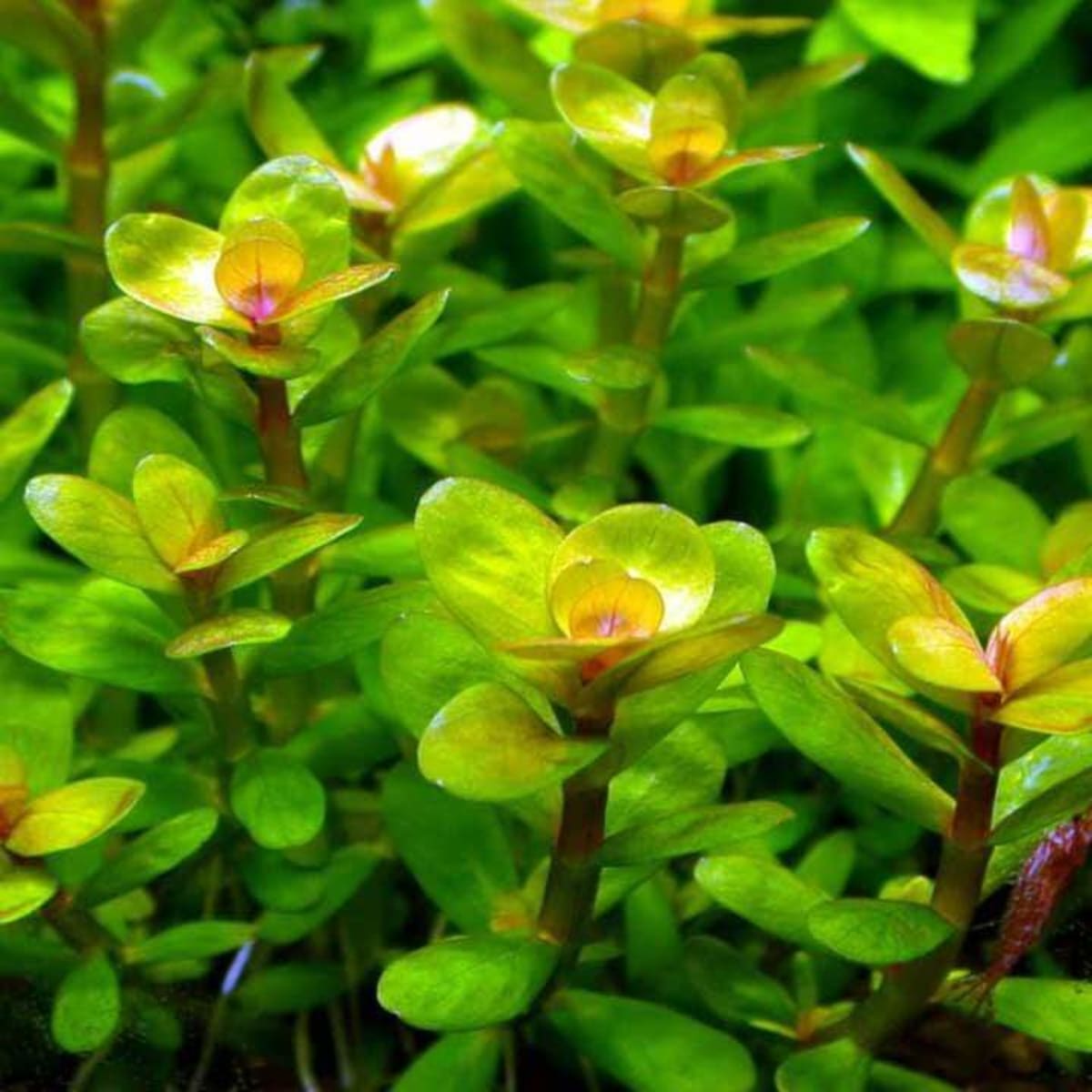
Rotala Indica/Bonsai - Image 1
plants

Rotala Indica/Bonsai

(4.1) · 45 reviews
$9.90 AUD
26 in stock

Product Description

True Rotala indica is not very well-known as aquarium plant. At the moment is it labeled as Ammania sp. "Bonsai" and Rotala sp. "Bonsai" as the trade names, but its flowers have helped identify it correctly as R. indica. The name Rotala indica has been known in the aquarium hobby for a long time, but it was erroneously used for the totally different species Rotala rotundifolia. The unique appearance of Rotala indica can best be described as compact miniature version of Bacopa caroliniana. R. indica is a slow grower; under a lot of light, the shoot tips and stems turn reddish. With its straight hardly ramified thick stems and its roundish leaves it is best planted in a group in the fore- or middle ground of a tank. Rotala indica is especially suitable for smaller aquaria, but a large group of this plant may look nice in a bigger tank, too. Good lighting (at least 0.5 W/litre) and an ample supply of CO2 and nutrients need to be made sure. Moreover, R. indica should not be planted in the shade.

  • Condition  New
  • Type:    Stem    
  • Origin:    Cultivar    
  • Growth rate:    Slow    
  • Height:    5 - 20+   
  • Light demand:    Medium     
  • CO2:    Medium 
    Priced per: 5 Stems ( Submerged Grown , size 5 cm each stem) 

    Key Features

    • Premium quality
    • AQUATIC SWAN DESIGN
    • Fast shipping
    In Cart: 0
    Available: 26
    Select Quantity:
    1
    Select how many items to add, then click "Add to Cart"
    Product Specifications
    Vendor
    Aquatic Swan Design
    Category
    Product_Plants
    Type
    Premium

    You May Also Likeplants category

    Anubias Afzelli
    plants

    Anubias Afzelli

    Anubias Afzelli Live Aquarium Plant

    $29.90 AUD
    Stock: 25 available
    View Details
    Echinodorus quadricostatus
    plants

    Echinodorus quadricostatus

    The genus-name Echinodorus comes from Greek 'echino' (bristle, prickle) and 'doros' (gift) and refers to the hedgehog-like seeds, the species-name quadricostatus means 'with four ribs' and refers to the seeds. Portion: 3-5 plants per bunch Synonyms: Echinodorus magdalensis, Echinodorus intermedius. Family Alismataceae Common Name: chain sword Location: Central and South America Echinodorus quadricostatus is a little plant that is appropriate for smaller tanks or as a foreground plant in bigger ones. The plant is 10-15 cm (4-6”) tall. It has 1-2 cm (.39-.78”) wide bright green leaves. The leaves are narrow lancet-shaped. This plant has characteristic light-green leaves which form a good contrast to the darker aquarium plants. It is most beautiful when planted in groups. In good conditions it produces runners which spread over the bottom. Growth is more compact when planted in a pot or between stones or other objects. Very light leaves are a sign of a shortage of micro-nutrients. There is some confusion about the name of this plant, and it has been sold as Echinodorus bolivianus var. magdalenensis. The plant can be very prolific in proper conditions and will grow in all types of water The species is known in three variants: var. quadricostatus, var. magdalensis and var. xinguensis (narrow leaf form). These are separated only by differences in the form of the leaves. Light requirements: medium-very high Echinodorus quadricostatus Temperature: 20-28 °C (68-82°F) Hardness tolerance: very soft-hard pH tolerance: 6-9 Growth: fast Propagation: Very prolific. Sends out runners. I got this plant for my upstairs 70 gallon display tank. This tank is a Fluval Osaka 260 tank. This is the tank with the rounded glass corners on the tank. This tank comes with 36" T5 high output double fluorescent fixtures with 2 bulbs. The tank is filtered with a Fluval 405. There are many different plants in this set up. I was able to try some plants I normally stay away from since this tank has better lighting on it than I normally have over my planted tanks. I did have an algae bloom problem for several months after setting the tank up. This was the type of algae that floats through the water. I just slowly kept adding plants and eventually this bloom disappeared. This plant didn’t do much at the beginning when I got it. It put out 3 little plants and stopped there. It stayed like that for over 3 months. Then one day while doing a water change I noticed something different about the quadricostatus plant. One of the little plants that the original plant had put out was growing like mad. It put out a really decent runner with lots of daughter plants on it. This runner made it out of the ground and kept growing daughter plants all the way up to the surface of the tank. I would think that there is at least 12 plants on that one runner. The catfish in the tank (farlowellas – 2 different species), have left this plant alone. The dwarf cichlids (Apistogramma borellii and Mikrogeophagus altispinosa) like to swim through the leaves but otherwise ignore the plants. I don’t add any fertilizers to my water. They get whatever comes from feeding the fish. The tank gets monthly water changes since it is lightly stocked. The Fluval gets cleaned out properly every 6-8 weeks. In the part of the tank that this plant is in, it’s created a little thicket of Echinodorus quadricostatus plants. I think if you let it, this interesting little plant could make a carpet in the foreground of your tank. I will be offering up this plant shortly to interested parties.

    $5.00 AUD
    Stock: 17 available
    View Details
    Cryptocoryne spiralis 'Tiger
    plants

    Cryptocoryne spiralis 'Tiger

    With 'Tiger' and 'Red', two pretty new forms of Cryptocoryne spiralis have entered the market via ADA few years ago. They are still rarely available in Europe. The Spiral water trumpet from southwestern India is an extremely polymorphic species, however the form 'Tiger' is unique. It resembles Cryptocoryne albida "Brown" but gets larger and grows faster. Its submerged leaves are very narrowly lanceolate with smooth to wavy edge, brown-red with dark "tiger stripes" that are more pronounced than in Cryptocoryne spiralis 'Red'. It also differs from the latter by wider, shorter, more spreading leaves under same growth conditions. Sometimes the midrib is vividly green, but less often than in 'Red'. In our aquariums, the 'Tiger' has formed nearly 30 cm long, 1,3 cm wide leaves but may become considerably taller. As several other Cryptocoryne spiralis forms, 'Tiger' is apparently a quite easy aquarium plant. Nutrient-rich substrate and CO2 addition are very beneficial for its growth. It is not a low-light plant, the lighting should be at least moderate, and strong light enhances its showy coloration. With time, daughter rosettes appear at the base of the plant that develops a tuft with many leaves and strong roots. The daughter plants can be cut off for propagation. We have not yet noticed long runners in C. spiralis 'Tiger'. Cryptocoryne spiralis 'Tiger' is an eye-catcher in not too small aquariums, best as a solitary bush in the midground. Its red-brown tones contrast well with light green plants

    $149.00 AUD
    Stock: 55 available
    View Details